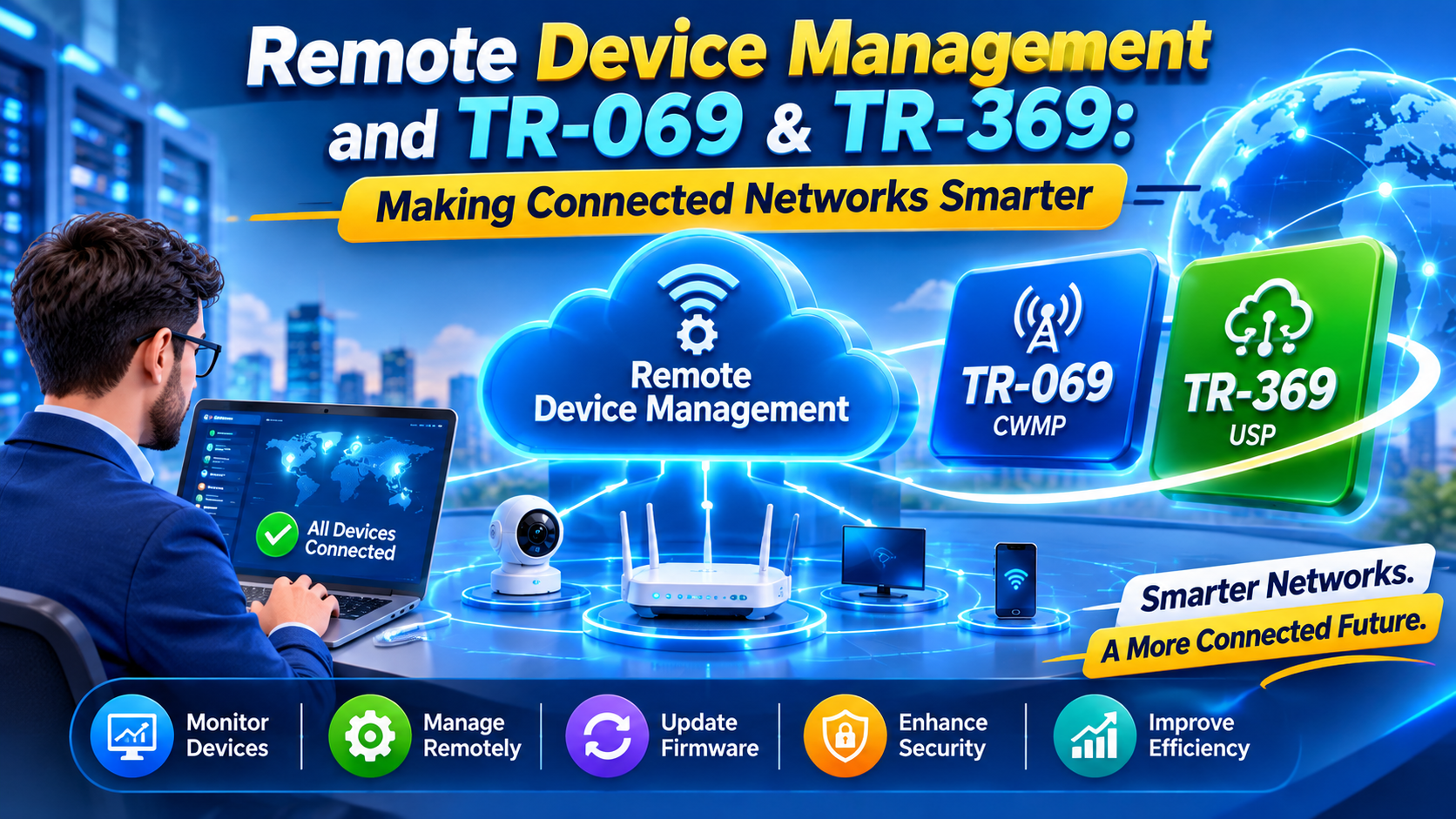
Today, businesses and internet service providers manage thousands of connected devices across different locations. From broadband routers and gateways to smart home devices, keeping everything connected and running smoothly is becoming increasingly important. Managing these devices individually can take time, increase operational costs, and create technical challenges. This is why Remote Device Management and modern communication standards such as TR-069 and TR-369 are essential for today’s connected networks.
What Is Remote Device Management?
Remote Device Management is a technology that allows businesses and service providers to monitor, configure, update, and troubleshoot connected devices without physically accessing them.
For example, an Internet Service Provider (ISP) may have thousands of Wi-Fi routers installed in customers’ homes. If a router experiences a connectivity issue or requires a software update, technicians do not always need to visit the customer’s location. Through a centralized management platform, they can remotely access supported device functions and perform necessary operations.
Some important benefits of Remote Device Management include:
- Remote Monitoring: Track device status and performance from a central location.
- Faster Troubleshooting: Identify and resolve common technical issues remotely.
- Firmware Updates: Maintain devices with updated software and security improvements.
- Centralized Control: Manage multiple devices through a single management interface.
- Reduced Operational Costs: Minimize unnecessary technician visits and manual work.
These capabilities help service providers improve efficiency while delivering a more reliable customer experience.
Understanding TR-069 and TR-369 Device Management
Communication standards play an important role in managing connected devices. TR-069 and TR-369 are two important standards developed by the Broadband Forum to support remote device management.
TR-069 (CWMP) is widely used by broadband service providers to manage customer-premises equipment (CPE), including routers and gateways. It enables remote configuration, monitoring, diagnostics, and firmware management through an Auto Configuration Server (ACS).
TR-369 (USP), also known as the User Services Platform, introduces a more flexible approach to managing connected devices. It supports multiple controllers, agents, and communication models, making it suitable for modern smart home and broadband environments.
Together, these technologies help service providers build more efficient and scalable device management systems.
Why Are These Standards Important for ISPs?
Internet service providers need reliable tools to manage growing device networks. Using TR-069 and TR-369 Device Management capabilities can help them automate routine tasks, improve device visibility, and simplify technical support operations.
These standards also support better control over device configurations and help service providers adapt to changing network requirements.
As connected homes and smart devices continue to grow, having flexible device management capabilities becomes increasingly valuable.
Simplify Device Management with Friendly Technologies
Managing a large connected-device network does not have to be complicated. With the right technology, businesses can improve monitoring, reduce manual operations, and provide better services to their customers.
Friendly Technologies offers device management solutions designed to support telecom operators, internet service providers, and connected-device ecosystems. Its Device Management platform and TR-369 USP Controller help businesses move toward smarter, more flexible, and efficient network management.
By adopting modern Remote Device Management solutions, service providers can build a stronger foundation for the future of connected technology.